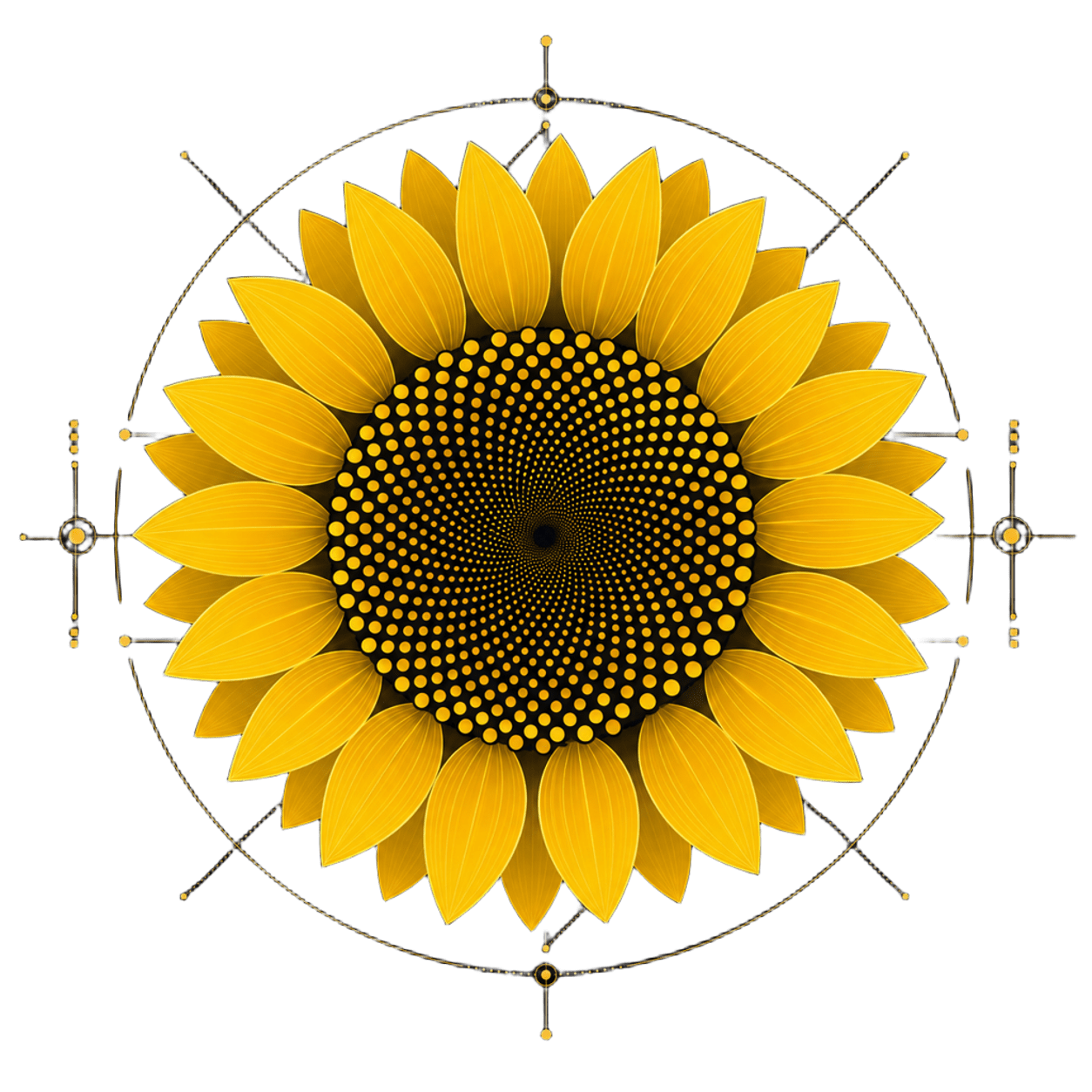

There is a sunflower beside my name, in my photographs and throughout this website.
It did not begin as a branding exercise. I kept returning to it because of the feeling it carries: warmth without noise, optimism with its feet in the ground, and a quiet instinct to turn toward light.
But emotion is only half the reason it stayed.
When I looked closer, I found something that felt even more familiar: a system.
Step closer and the flower changes
From a distance, a sunflower is one clear yellow face. Up close, its centre is made of hundreds of small florets arranged in interlocking spirals.
In a common mathematical model of this growth, each new floret appears at roughly 137.5 degrees from the previous one—the golden angle. Because that turn does not resolve into a simple fraction of a circle, new growth avoids repeatedly lining up in the same direction. Space is used remarkably well.
The visible spirals often appear in neighbouring Fibonacci counts such as 34 and 55, or 55 and 89. I like the beauty of that pattern, but I like the truth even more: real sunflowers are not diagrams. Research has found Fibonacci structure to be common, not universal. Some heads vary. Some patterns are difficult to count. Nature keeps its character.
One small decision, repeated with patience, can become a structure no grand sketch could fully predict.
That is where the sunflower began to feel personal to me—not because software is a flower, and not because mathematics can make business decisions for us. It is personal because the pattern describes the discipline I want to bring to the work.
The part of digital work most people never see
I build apps, websites, ecommerce journeys, automations and the systems underneath them. The page a customer sees is usually one small part of the real product.
With EdenMish, I was the principal architect and hands-on builder of the system end to end: a booking page continues into pricing, payment handoff, operations, courier activity, live tracking, proof of delivery and the driver app. With Engage, collecting and classifying a message is not enough; the system also needs a deliberate human-approval boundary before a public reply. With ZUZU MindPlay, the app sits inside a wider journey of children, parents, subscriptions, websites, analytics and partner infrastructure.
If those parts are designed as separate screens, the gaps appear later—in the hands of a customer, an operator or a business owner. My job is to see the whole disk while still caring about every seed.
How the sunflower enters the work
Find the largest open gap
Every project arrives with noise: ideas, requests, constraints, old tools and things people have learned to work around. I try to find the place where the next decision will create the most value with the least duplication. Sometimes that is a new feature. Sometimes it is removing one. Sometimes it is connecting two steps that should never have been separate.
Let every part earn its place
A convincing product is not the one with the longest feature list. It is the one where the important journey feels complete. Customers should not have to understand the architecture. They should simply feel that the system knows where they are and what needs to happen next.
Build honestly, then learn
I do not believe an early idea needs to pretend it is already a finished company. A useful first version should answer a real question. Then real use teaches us what deserves to come next. This is why I show project status plainly—live, in development, staging or beta—and why I do not invent numbers to make a story sound larger.
Choose the path that fits the problem
The fashionable tool is not always the right tool. The easy answer is not always the useful one. I choose technology, scope and pace around the business, the people doing the work and the responsibility the product carries.
The rhythm is simple:
Understand the space. Place the next useful piece. Connect it. Learn. Turn toward the light and continue.
The goal is not more software
The goal is clarity.
A customer knows what to do. A team knows what happened. A business owner can see the system instead of chasing fragments across screens and conversations. The product is useful on its first honest day, and capable of growing without losing its shape.
That is also why security and accessibility belong inside the work, not at the edge of it. Who may see information? What happens when a flow is misused? Can more people complete the journey? A connected system has to carry those questions from the beginning.
Why it remains my symbol
Young sunflowers track the sun as they grow. Mature flowers usually settle facing east, ready for the morning. I do not need to turn that biology into a promise or a slogan. The image is enough: rooted, responsive, useful, and oriented toward light.
The sunflower reminds me that professional work can still have spirit. That precision does not have to feel cold. That many complicated parts can become one clear experience. And that progress does not have to begin with a grand performance—it can begin with one honest next decision.
One seed. One decision. One useful next step.
Then another.
That is the story I want my work to tell.
If you are holding an unfinished idea
You do not need a perfect brief. You may have an early idea, a live product that feels stuck, or a manual process that has grown too complicated. Bring me the real situation. We can find the open gap, decide what belongs there and build the next useful piece together.
Sources behind the science
The sunflower is my interpretation; the biology deserves careful language. These sources informed the factual parts of this story: